Seven artists explore the darker side of plants in new Burlington exhibition
The show at BCA Center runs through January 23, featuring paintings, ceramics, and digital animations that frame botanical subjects with unease and mystery.
By Sophie Lawson ·
A new exhibition at BCA Center in Burlington presents a collection of botanical art that leans into the unsettling nature of plant life. The show, titled Dark Botanica, is currently on view and will remain open to the public through January 23. It features works from seven artists who use various mediums to examine flowers and vegetation through a lens of shadow, reproduction, and alienness.
New York City artist Alina Bliumis contributes a series of paintings called Plant Parenthood. These watercolor-on-wood pieces depict flower species historically used to terminate unwanted pregnancies. Bliumis uses a textural style that resembles crayon or colored pencil, giving the images a folk-art quality. Each painting is framed in velvet, evoking the decor of old-fashioned bathrooms. The works focus on the reproductive organs of plants, presenting them with a confrontational, straight-on composition that acknowledges women's historical use of botanical knowledge for bodily autonomy.
Stowe artist Marcie Scudder displays an installation titled My Mother's Garden in the same gallery. Scudder inherited a large garden from her mother, a Holocaust survivor who planted it as an act of healing. The artist has transformed photographs of the plants into geometric paper flowers, which are cut, folded, and sewn into garlands that drape from the ceiling. The piece references the intergenerational transfer of gardening knowledge and craft traditions. It also highlights how easily this specific type of maternal knowledge can be lost over time.
The exhibition includes sleeker, more polished works from New Yorker Dylan Griffin and British artist Sian Fan. Griffin’s still lifes, such as Spanning and Zuhur, combine flowers with metal wire and tubing. His background in commercial product photography is evident in the exquisite lighting and sharp definition of the objects. One piece, Velo, masks a bouquet with a chartreuse blur, while Frukt uses a backlit silhouette of flowers and rocks emerging from metal grids. These images position cut flowers as objects within a seamless ecosystem of natural and human-created forms.
Fan’s contribution consists of two 30-second animated videos titled Dream Diver and Stinger. The animations feature glowing, magical flowers that appear to be sculpted in virtual reality. The blossoms unfurl and close with smooth, mathematical movements that resemble folding origami. Ambient soundtracks by Ben Dixon accompany the visual sequences. The work presents the flowers as characters that might savor or restore a viewer’s vitality, creating a narrative ambiguity that feels both game-like and serious.
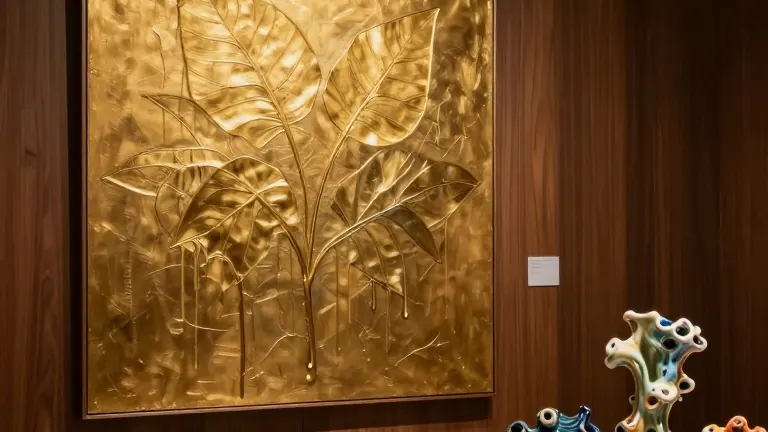
Large-scale paintings by Charlotte-based artists Cameron Davis and Sage Tucker-Ketcham occupy the main gallery spaces. Davis presents Poetic Ecologies Series, Listening for the Lyrics, a three-panel piece nearly 7 feet high and 15 feet wide. The composition is primarily metallic gold, organizing a chaos of representational leaves with drips and stains. The palette reveals burgundy, turquoise, peach, green, and orange upon closer inspection. The lack of a solid ground in the composition creates an unstable effect, similar to leaves floating on a pond.
Tucker-Ketcham anchors the back gallery with three vertical works, each measuring 3 by 5 feet. These paintings use a red-to-green spectrum, a shift from the blue-green palette of her solo show two years ago. Delicate fronds, seeded grasses, and tangled weeds stand close to the picture plane. Red blobs suggest both blossoms and wounds, while pops of pale blue sky peek through dark green shadows. The works depict the scrub at the edge of a garden as a place that is both fantastical and real.
Megan Bogonovich’s ceramic sculptures from her Dark Botanicals series are clustered on a table in a reef-like arrangement. The pieces feature glazes ranging from black to opalescent and textures that include raised scales, painted stripes, and spongelike holes. Some sculptures reference reproductive organs, noting that parts of flowers are biologically male. The works are colorful and goofy, yet they maintain an inscrutable quality that hints at a subtle threat. A panel discussion related to the exhibition is scheduled for January 14 at 6 p.m. at the center.
Source: Seven Days · original report published
More Culture · Burlington news · Report a business · Got a Story?