
Gulf states seek new defense partners
Rising costs and U.S. withdrawal push Arab nations to build regional air defenses with Turkey, Pakistan, and South Korea.
By Trevor Wilson ·
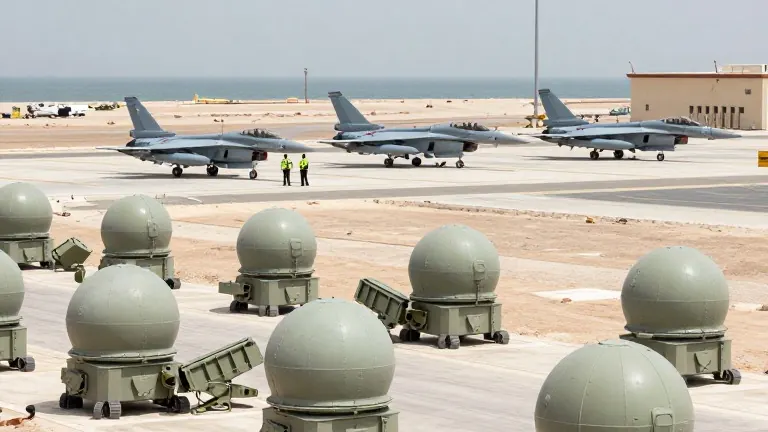
Gulf Arab states are expanding military partnerships with middle powers to offset a perceived decline in U.S. security guarantees. As the United States reports it may escalate its war against Iran after midterm elections, regional allies are turning to a growing network of partners from Europe, Asia, and the Middle East. These new arrangements aim to bolster regional defenses and intensify diplomacy with Tehran.
The shift follows an Iran war that exposed vulnerabilities in the region. Gulf states relied heavily on expensive defenses to counter cheap Iranian drones. They also lacked domestic production of interceptors and munitions. Abdulaziz Sager, chairman of the Gulf Research Center in Jeddah, stated that the conflict made diversification urgent by showing the risks of depending on a single security partner.
Military deployments have already begun. Following Houthi attacks on Saudi airports, ports, and residential areas in October, British and French warplanes joined the defense effort. The Mecca Pact, a mutual defense agreement signed in August between Saudi Arabia, Pakistan, and Turkey, was triggered. This month, Turkey and Pakistan sent troops and anti-drone systems to Saudi Arabia and Aden in Yemen. Egypt’s parliament also approved sending troops to the kingdom.
South Korea sent emergency missile resupplies to the United Arab Emirates. These supplies support Cheongung-II batteries deployed there to intercept Iranian missiles. French, British, and Italian forces have also been deployed to Bahrain and Qatar. Hesham Alghannam, a Saudi political analyst in Riyadh, noted that these partners offer cheaper weapons, faster innovation, and technology transfer.
Gulf capitals view the United States with increasing frustration. Multiple officials told the Christian Science Monitor that no similar enhancing of U.S. missile-defense systems has been provided to Gulf allies. This is despite the U.S. sending an additional Patriot system to Israel. Hasan Alhasan, a senior fellow at the International Institute for Strategic Studies in Manama, said there is deep frustration with the U.S. de-prioritizing Gulf defense compared to Israel.
The alliances also focus on local production. After spending hundreds of billions of dollars on U.S. arms since 2000, Gulf states aim to manufacture their own munitions. Turkish firm Baykar plans to open factories in Saudi Arabia to build unmanned aerial vehicles. Last week, Qatar signed a defense industry agreement with Indonesia, Turkey, and Pakistan. This deal includes technology for radar, electronic warfare, and anti-drone systems, with Qatar providing investment and purchasing production for a new hub in Doha.
Decision-makers in Riyadh view these partnerships as relationships of equals rather than the hegemon-junior-partner dynamic that has dominated the region since World War II. However, the U.S. withdrawal is leaving each state to pursue its own network. Saudi Arabia is strengthening ties with Turkey, while the UAE cements ties with Israel and South Korea. Alhasan stated that the Gulf states are not coming together to enhance collective deterrence, but are seeing a range of alliances play out.
Observers agree these patchwork alliances cannot yet replace superior U.S. firepower and intelligence. Sager warned that no partnership can fully insulate the Gulf from the consequences of another major escalation. Alhasan predicted that a further round of hostilities would be a strong test of what these new relationships can actually bring to the table.
Source: The Christian Science Monitor