Canadian Analysts See Threat in U.S. Ties With Moscow
Former security advisers say shifts in American policy toward Russia put Canada's sovereignty and defense arrangements at risk.
By Sophie Lawson ·
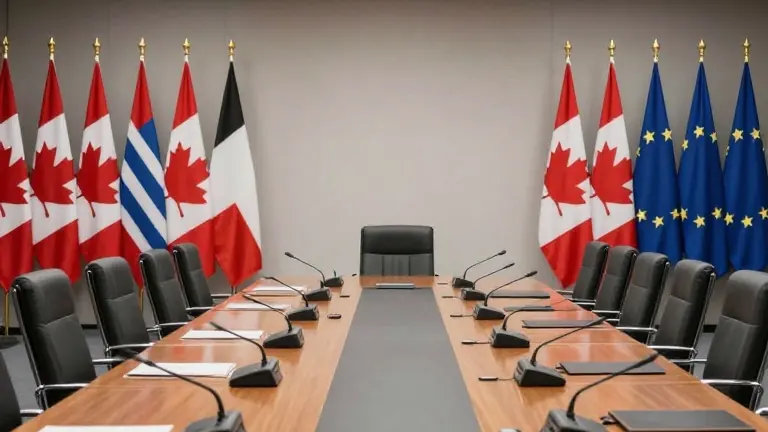
Canada has spent the past six weeks watching Washington draw closer to Moscow, and former national security officials in Ottawa now say that alignment could imperil Canadian sovereignty. Prime Minister Mark Carney traveled to the European Parliament in late August; senior European Union officials arrive in Montreal for a joint summit this week. In between, the United States altered its posture toward Russia on several fronts at once.
Secretary of State Marco Rubio invited Vladimir Putin to a Group of 20 gathering set for Miami in December, days after Carney returned to Ottawa. Washington lifted sanctions on Russian oil on Oct. 9 and disclosed a contract to purchase diesel directly from Russia. Vincent Rigby, who served as national security and intelligence adviser to the prime minister through 2021, described those steps as "not Trump playing footsie with Putin" and something "far, far more serious."
Under an arrangement Trump labeled an "energy ceasefire," Ukraine was to stop striking Russian refineries while Russian strikes on Ukrainian power infrastructure continued. Starlink and Starshield service then degraded, and the White House and Elon Musk blamed each other for the slowdown. The United States also apparently halted alerts to Kyiv on inbound ballistic missiles. Volodymyr Zelenskyy said acquiring Patriot systems has grown more difficult.
Rob Huebert of the University of Calgary said those measures amount to an effort to force Ukraine toward defeat. Washington has also pressed European governments to unfreeze billions of euros in Russian-held assets, and Trump signed an order waiving sanctions on Russia. Maria Popova, who studies Russia at McGill University, said the administration spent its first year pulling the United States toward neutrality in the war and now appears to be pursuing an open partnership with Putin. In her assessment, that trajectory ends with American support for Russia's military.
Rigby said closer ties between Washington and Moscow raise questions about Arctic sovereignty and that a worst-case outcome "could be the end of NORAD." Huebert proposed a narrower explanation for the fuel deals, suggesting they may aim to soothe American voters upset about prices ahead of the midterms, and he said the remaining policy changes resist that reading.
A proposed three-way session with Putin and Xi Jinping has renewed concern that Trump intends to substitute the postwar alliance structure for an arrangement among three governments. Yuri Ushakov, a Kremlin foreign policy aide, said preparations are underway for a summit around the Nov. 18-19 APEC meeting in Shenzhen, China. Popova said such a meeting could determine outcomes for Canada or Taiwan. Rigby said middle powers would be pushed to the margins, a point Carney made at Davos.
Canada is forming new partnerships, rebuilding military capacity, and working to keep its bilateral channels with Washington operating. Rigby said Ottawa must turn to Europe for defense-industrial cooperation, technology sharing, payment arrangements less vulnerable to American pressure, and satellites independent of Musk or the Pentagon. Geography narrows those choices: Ukraine borders four EU members and can be resupplied, while Canada would stand largely alone in a confrontation with the United States.
Polling cited by analysts shows most Americans, Republicans included, neither favor Trump's Russia stance nor back his trade war with Canada. Trump has 26 months remaining in office unless he subverts the Constitution. Rigby expects turbulence across that period and said Canadians could encounter a president after next week who is "even more reckless, less restrained and more aggressive."
Canada is set to receive senior European Union officials in Montreal this week for a joint summit.
Source: CBC News