European Youth Unrest: Serbia's Vucic Falls as Protests Spread
Student-led demonstrations have forced the removal of Serbia's leader and triggered unrest in Albania and Germany, driven by economic strain and educational deficits.
By Trevor Wilson ·
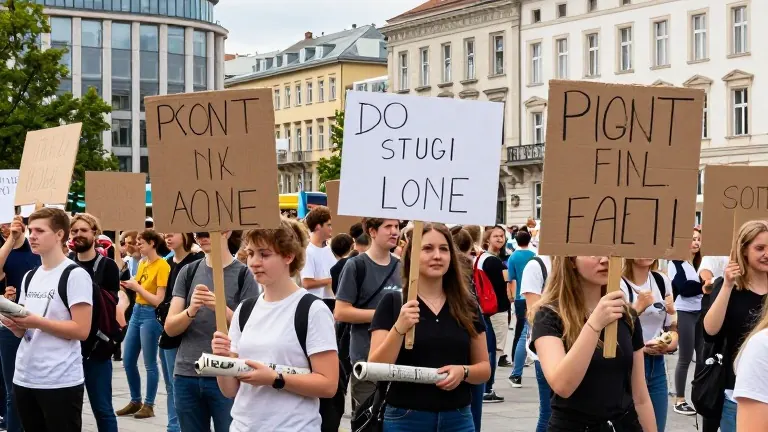
Aleksandar Vucic has been removed from power in Serbia following nearly two years of student-led protests against corruption and authoritarianism.
The fall of the long-time leader marks a tangible political shift in Europe, where young demonstrators are increasingly influencing national governments. In Serbia, the outcome was immediate, with student Stasa Piletic describing a sense of relief and freedom upon waking after the change. She noted that the movement had moved from street protests to a position of responsibility, signaling a transition from opposition to governance.
Economic pressure drives much of the anger across the continent. A 2025 European Union survey found that 40% of 16 to 30 year olds cite cost of living as a primary concern. Poverty and social exclusion risks are highest among adults aged 18 to 24, with 26.3% of this group at risk, compared to 18.8% for those over 65. In France, the OFCE think tank reports that people over 60 own 60% of the wealth despite comprising only a quarter of the population. This disparity fuels resentment, as younger voters feel their financial future is being compromised by the spending habits of older generations.
Educational infrastructure and funding also play a central role in the unrest. In Milan, 21-year-old student Chiara described schools with crumbling buildings and a lack of teachers. She stated that the ruling class stole the ability to imagine a future, forcing students into underpaid jobs and overpriced housing. In a suburb north of Paris, 17-year-old Bilal Narjissi highlighted deplorable school conditions, including a roof collapse last year that required evacuation. A French government report from October 2025 indicated that pension spending rose by 2.5 percentage points of GDP between 2000 and 2023, while education spending fell by 0.5 percentage points, with 32% of the education budget now going toward pensions.
The movement is expanding beyond Serbia and France. Unrest has reached Albania, where student protests against Prime Minister Edi Rama have spread from Tirana to other cities. Xyke Kurti, a 19-year-old architecture student, argued that connections often outweigh talent and that most students see their future outside the country. A demonstration is also planned for Germany this weekend, focusing on inequality, war, and the state of schools. The protests in Europe have been joined by similar movements in Bangladesh, Nepal, and India, reflecting a global pattern among those born between 1997 and 2012.
While Serbia’s outcome provided a clear victory, other nations face ongoing tensions. In France, thousands of shops were damaged or looted in recent weeks, and police used stun grenades and water cannons. Maya Gourdel, a 19-year-old student in Brussels, noted that passive methods failed to attract media attention until more dramatic actions occurred. The demonstrations continue as young people demand greater influence over economic and social policy.
Source: The Jerusalem Post