Bates numbers reveal gaps in Epstein release
A coding analysis identifies 1.2 million missing pages, while internal logs show classified material reached the Attorney General's office in March 2025.
By Trevor Wilson ·
The release of documents under the Epstein Files Transparency Act has drawn scrutiny over missing pages and internal contradictions regarding the handling of sensitive information.
Attorney General Todd Blanche previously stated that no files were withheld or redacted for national security reasons. However, internal records indicate that the Office of the Deputy Attorney General received classified material related to the case in March 2025. Federal law restricts the classification of documents to national security purposes.
One document in the released files logs the delivery of 16 items to the Deputy Attorney General on March 25, 2025. Items two and six are labeled as classified material, including two CDs. The Epstein Transparency Project, the department's review effort, identified three documents as remaining classified. One was an FBI document that is classified when visible, while descriptions of the other two were redacted.
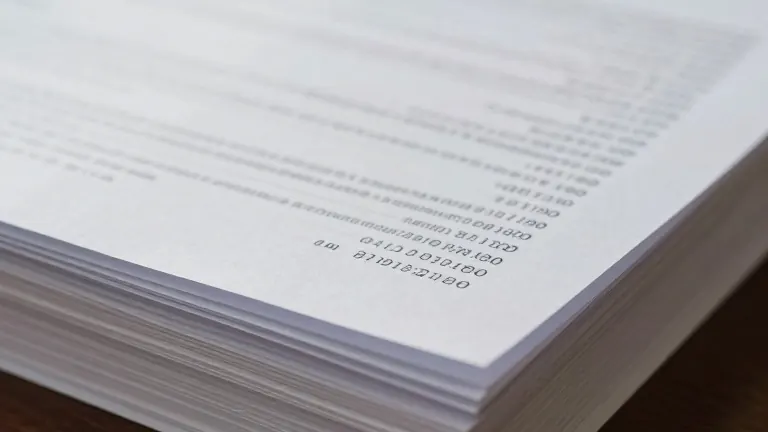
An analysis of the Bates numbers used to organize the files reveals significant gaps in the sequence. The released documents range from page 1 to 2,858,498. Older coding numbers from previous legal cases appear alongside the new EFTA stamps. When these older codes skip numbers while the EFTA numbers remain sequential, it indicates that pages were removed after the department obtained them.
The gaps appear frequently in Epstein's financial records. In one series of approximately 4,500 check images, 66 pages are missing. In many instances, only the front or back of a check was removed, though in several cases both sides are absent. Barbara McQuade, a former U.S. Attorney, noted that financial records were not a permissible category for removal. She stated that Bates numbers exist specifically to allow for such detection.
A separate coding sequence labeled R1 appears across roughly 995,000 pages. Gaps in this sequence range from one page to hundreds of pages. Comparing the first and last numbers in this earlier sequence to the final release shows a difference of 1.2 million pages. These missing pages primarily consist of emails between Epstein, Ghislaine Maxwell, his assistant Lesley Groff, and various business associates.
Department instructions allowed attorneys to mark interstitial emails in a chain as duplicates if the most inclusive email was already reviewed. This process aimed to speed up redactions by removing redundant back-and-forth messages. Duplicate emails still exist within the released files, suggesting the process was not uniformly applied. It is unclear if the removals were intentional or the result of error.
Independent journalist Katie Phang is suing the Department of Justice to obtain an explanation for the redactions and removals. A federal judge has ruled in her favor on several occasions, and the department is appealing those decisions. Phang asked the court to appoint a special master to review the files. She described the current state as making the department look bad, regardless of whether the omissions were intentional or due to negligence.
The department has acknowledged specific errors, including the temporary removal of a photo of Commerce Secretary Howard Lutnick from an image. Officials also previously claimed a photo from the night of Epstein's death was missing, which was later found. Stanley Brand, a law and government fellow at Penn State Dickinson Law, said the process inhibits public trust. He noted that the government's handling of the files fuels suspicion that certain documents are being hidden from view.
Source: CBS News